info@luxedentalarts.com



Implant failure doesn’t always come down to surgical error or poor oral hygiene. Sometimes, it starts with a deficiency that has nothing to do with your mouth at all and that most people don’t even know they have. Vitamin D is one of the most underdiagnosed deficiencies in the United States, with research from the National Health and Nutrition Examination Survey estimating that over 40% of American adults have insufficient levels. For patients pursuing tooth replacement, that number matters far more than most conventional dental offices acknowledge.
The Vitamin D–Bone Connection You Can’t Ignore
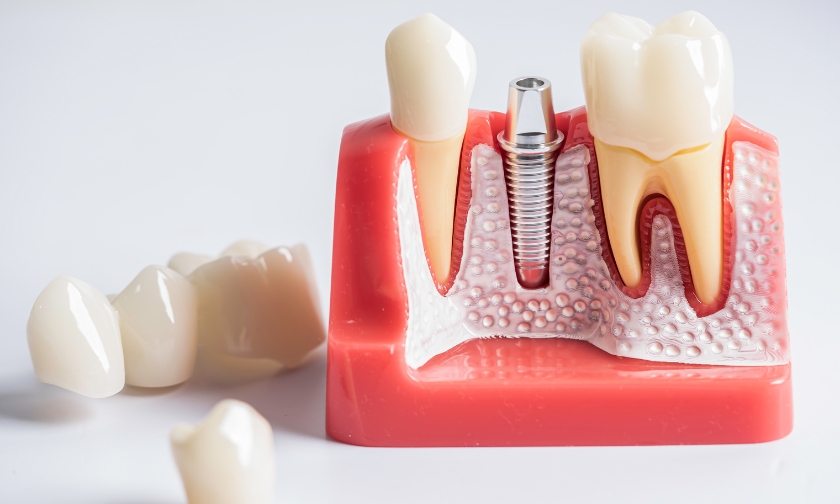
Osseointegration (the process by which an implant fuses to the jawbone) is a biological process. It depends on your body’s ability to build and mineralize new bone around the implant post. That process requires calcium. And calcium absorption requires Vitamin D.
Without adequate Vitamin D, your body simply cannot absorb calcium efficiently from food or supplements, no matter how much you consume. The result is softer, less dense bone (a condition called osteomalacia in adults), which creates a poor foundation for osseointegration. The implant may appear to integrate initially, only to loosen or fail months later as the surrounding bone proves unable to sustain the load.
This is why a holistic approach to tooth replacement, including nutritional assessment before placing an implant, makes such a meaningful difference in outcomes. At Luxe Dental Arts, Dr. Karishma Sheth evaluates the full picture of your health before recommending a zirconia implant restoration, because placing a biocompatible implant into a body that isn’t nutritionally prepared to support it defeats the purpose.
Who Is Most at Risk?
Vitamin D deficiency doesn’t always produce obvious symptoms. Many patients feel completely fine, which makes it easy to miss. Certain groups, however, carry a statistically higher risk:
- People who spend most of their time indoors or live in climates with limited sunlight exposure
- Individuals with darker skin tones have higher melanin, which reduces the skin’s ability to synthesize Vitamin D from sunlight
- Older adults, whose skin becomes less efficient at producing Vitamin D with age
- Those with obesity, since Vitamin D is fat-soluble and can become sequestered in adipose tissue
- People with conditions affecting fat absorption, such as Crohn’s disease or celiac disease
In Sugar Land and the broader Houston area, it might seem counterintuitive to worry about sun exposure given the Texas climate. But indoor-heavy lifestyles, office work, and the use of broad-spectrum sunscreen mean that sun-related Vitamin D synthesis is often lower than expected, even in sunny regions.
What Undiagnosed Deficiency Looks Like in an Implant Patient
The usual reasons behind implant failure include infection, poor bone volume, or patient non-compliance with post-surgical care. What gets discussed less often is the patient who does everything right and still ends up with a failing implant.
These are often the patients whose Vitamin D levels were never checked. Their bone may look adequate on a CBCT scan — 3D imaging that Luxe Dental Arts uses as a standard part of its holistic treatment planning, but the quality of that bone is compromised at the cellular level. Osteoblasts (the cells responsible for building new bone) depend on Vitamin D receptors to function properly. Without sufficient Vitamin D, their activity slows, new bone formation is impaired, and the integration process stalls or fails.
Why Zirconia Implants Fit Into a Whole-Body Approach
From a holistic dentistry standpoint, the material of the implant matters just as much as the health of the patient receiving it. Titanium implants introduce metal into the body. For patients with compromised immune function, systemic inflammation, or metal sensitivities, titanium can contribute to ongoing immune activation, which impairs healing at the implant site.
Zirconia, by contrast, is bioinert. It doesn’t corrode, release ions into surrounding tissue, or trigger immune responses the way metallic materials can. Its smooth surface resists bacterial adhesion, supporting healthier peri-implant tissue over the long term. For patients working to optimize their systemic health, including addressing a Vitamin D deficiency, choosing a zirconia implant restoration reduces the inflammatory burden on the body and creates the most favorable environment for successful osseointegration.
Dr. Karishma Sheth’s approach at Luxe Dental Arts integrates these considerations from the very first consultation. Patients in Sugar Land, Missouri City, Stafford, and the surrounding communities receive a comprehensive health review, not just a tooth-by-tooth treatment plan.
What Patients Can Do Before Their Implant Procedure
If you’re considering implants, addressing Vitamin D status before your procedure is one of the most proactive steps you can take. Here’s a practical starting point:
Request a Vitamin D blood test. A simple 25-hydroxyvitamin D serum test tells you where your levels stand. The optimal range for bone health is generally considered to be between 40–60 ng/mL, though this should be discussed with your physician or care team.
Optimize through diet and supplementation. Fatty fish, egg yolks, and fortified foods contribute dietary Vitamin D, but supplementation is often necessary for patients who are significantly deficient. Your healthcare provider can recommend an appropriate dose based on your lab results.
Allow time for correction. Restoring Vitamin D levels to an optimal range typically takes several weeks to months. Timing your implant consultation accordingly gives your body the best foundation for successful integration.
Communicate openly with your dental team. At Luxe Dental Arts, this information is welcomed and factored into your care. Holistic and biological dentistry operates on the principle that what’s happening inside your body shapes what happens at the surgical site.
Your Implant Success Starts Before the Procedure
Tooth replacement is rarely just a dental decision — it’s a health decision. And when you approach it that way, you significantly improve your odds of a lasting, comfortable result. Vitamin D is one piece of a larger picture that includes bone quality, immune function, nutritional status, and material biocompatibility.
Luxe Dental Arts serves patients throughout Sugar Land, Pearland, Katy, Richmond, and the Houston metro area from their Sugar Land office. Dr. Karishma Sheth and the team take the time to ask the questions that conventional dental offices often skip because they believe your implant success depends on your whole-body health, not just the implant itself.
People Also Ask
Can I get a Vitamin D test at my dental office?
Dental offices don’t typically administer blood tests, but holistic practices like Luxe Dental Arts can identify risk factors and refer you to your physician for testing. Coordinating this before implant placement is an important part of a comprehensive treatment plan.
How long does it take to correct a Vitamin D deficiency before getting implants?
It depends on how deficient you are. Mild insufficiency may be corrected within 8–12 weeks with supplementation. More significant deficiencies can take several months to normalize, which is why early testing and coordination with your doctor is so valuable.
Are zirconia implants stronger than titanium?
Zirconia is highly durable and performs well under normal chewing forces, though titanium still has a slightly higher flexural strength in laboratory testing. For most patients, zirconia provides excellent long-term function along with the added benefit of being completely metal-free and bioinert.
Does Vitamin D deficiency affect gum tissue healing as well?
Yes. Vitamin D plays a role in immune regulation and soft tissue healing, not just bone formation. Deficiency can slow gum tissue recovery after surgical procedures and increase susceptibility to post-operative infection, making adequate levels important for full implant site healing.
What other nutritional factors affect implant success?
Magnesium is critical because it works alongside Vitamin D to support calcium metabolism and bone mineralization. Vitamin K2 helps direct calcium to bone rather than soft tissue. Protein intake also affects the rate of healing and bone formation. A holistic dental consultation can help identify gaps specific to your health profile.