info@luxedentalarts.com



If your implant site is swollen, tender, or not healing as it should, you can be assured that not everything is alright with your oral health. You’ve been told the placement went well, but the discomfort lingers. Before you spiral into worst-case scenarios, it helps to understand what’s happening because “implant rejection” and a metal allergy are two very different things, and they require very different conversations with your dental team.
Implant Rejection Is Rare, But Titanium Sensitivity Is Not
The term “rejection” is used loosely, which creates unnecessary fear. Genuine implant rejection, where your immune system mounts a targeted response against the implant material, the way it might reject a transplanted organ, is extremely uncommon with dental implants. Titanium, the material used in the vast majority of conventional implants, has been placed in millions of patients with a documented long-term success rate above 95%.
That said, a subset of patients does experience adverse reactions to titanium, and this is where things get more nuanced. True titanium allergy is rare, but titanium hypersensitivity and low-level immune reactivity are increasingly documented in the literature. A 2019 review published in the Journal of Oral Rehabilitation found that titanium particles released through implant surface wear and corrosion can trigger localized inflammatory responses in susceptible individuals – responses that look a lot like rejection but aren’t technically the same thing.
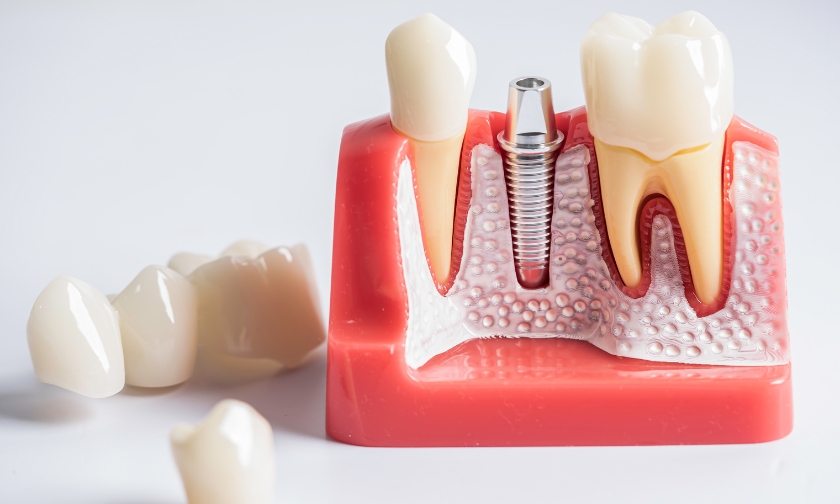
For patients who experience persistent peri-implant inflammation, delayed healing, or systemic symptoms after implant placement, a zirconia implant restoration offers a well-documented, metal-free alternative that eliminates this variable entirely. At Luxe Dental Arts in Sugar Land, Texas, Dr. Karishma Sheth evaluates each patient’s immune and health profile before recommending any implant material because what goes into your body should work with it, not against it.
What Does Titanium Sensitivity Actually Look Like?
This is genuinely difficult to identify without proper evaluation, because the symptoms overlap significantly with other post-surgical complications like infection, occlusal overload, or peri-implantitis. Common presentations include:
- Persistent swelling or redness at the implant site that doesn’t resolve as expected after healing
- Skin reactions such as eczema, hives, or rashes – sometimes appearing away from the surgical site
- Chronic fatigue or unexplained malaise following implant placement
- Taste disturbances or a metallic sensation in the mouth
- Ongoing pain or sensitivity that doesn’t have a mechanical or infectious explanation
The challenge is that most conventional dental practices don’t screen for metal sensitivity before implant placement. If a patient develops symptoms, the standard response is often to rule out infection first, but if the infection is cleared and symptoms persist, titanium sensitivity is frequently left uninvestigated.
The Difference Between Rejection, Allergy, and Failed Osseointegration
These three scenarios are constantly conflated, and separating them matters for getting the right treatment.
Failed osseointegration is the most common cause of early implant failure. It happens when the implant simply doesn’t bond with the surrounding jawbone, often due to inadequate bone density, compromised healing conditions (smoking, uncontrolled diabetes, poor nutrition), or infection at the surgical site. The implant loosens or becomes mobile, usually within the first few months. This is a biological failure of the bone-healing process, not an immune reaction.
Titanium allergy or hypersensitivity involves an immune response to the implant material itself or to the ions and particles it releases over time. It can develop even in patients who tolerated earlier exposure to titanium without problems. Symptoms may appear locally (at the implant site), systemically (skin, fatigue, joint pain), or both. Patch testing and lymphocyte transformation testing (LTT) can help identify titanium reactivity, though these aren’t routinely offered in conventional dental settings.
True rejection, as mentioned, is vanishingly rare with dental implants compared to transplanted organs or devices with active biological components. The body can form a fibrous capsule around a foreign material, called fibrous encapsulation, rather than fusing with it, which can cause implant instability. But this is distinct from the immune-mediated rejection seen in organ transplantation.
Understanding which of these is actually occurring shapes the entire treatment path forward.
Why Holistic Dental Practices Approach This Differently
Conventional implant dentistry is largely material-agnostic – titanium is placed because it works for most people and has decades of research behind it. Holistic and biological dental practices like Luxe Dental Arts take a different starting point: they ask whether a given material is right for this specific patient, not just for the average patient in a clinical trial.
That distinction leads to a different pre-treatment process. At Luxe Dental Arts, biocompatibility testing can assess how a patient’s immune system is likely to respond to various dental materials before placement. For patients with known autoimmune conditions, metal sensitivities, or complex health histories, this step can prevent a significant amount of downstream suffering.
Zirconia is the material of choice in this approach because it is genuinely bioinert. It doesn’t corrode, doesn’t release ions into surrounding tissue, and doesn’t present the immune system with the kind of particulate challenge that titanium surfaces can produce over time. Its smooth ceramic surface also discourages bacterial biofilm accumulation, supporting healthier peri-implant tissue – a real advantage for patients in Sugar Land, Missouri City, Stafford, Richmond, and the surrounding Houston communities who want tooth replacement that supports their overall health, not just their smile.
What to Do If You’re Experiencing Symptoms After Implant Placement
Don’t wait and hope it resolves on its own. A few practical steps:
Go back to your dental provider and describe your symptoms clearly. Note when they started, whether they’ve changed over time, and whether you have any systemic symptoms (fatigue, skin changes, joint discomfort) alongside the local ones.
Ask specifically about titanium sensitivity testing. If infection has been ruled out and your symptoms persist, request a referral for patch testing or lymphocyte transformation testing through an allergist or integrative medicine physician.
Consider a consultation with a holistic or biological dental practice. Practices that regularly place zirconia implants, like Luxe Dental Arts, are often better positioned to evaluate material-related complications and discuss options for transitioning to a metal-free restoration.
Don’t ignore systemic symptoms. If you’re noticing fatigue, rashes, or other changes without a clear explanation, bring your implant timeline to your primary care physician’s attention. The connection isn’t always obvious, but it’s worth investigating.
Your Body Deserves Materials It Can Trust
Implant dentistry has come a long way, and for most patients, conventional titanium implants work well. But “most patients” isn’t every patient. For those who notice something isn’t right after placement, the solution is to dig deeper and find out what’s causing it.
Luxe Dental Arts is located in Sugar Land and serves patients throughout the greater Houston area, including Pearland, Katy, and Clear Lake. Dr. Karishma Sheth takes a whole-body view of dental health, using biocompatibility evaluation and metal-free materials to minimize immune burden and support real, lasting healing.
People Also Ask
Can titanium implants cause autoimmune flares?
Emerging evidence suggests that titanium particle release can contribute to chronic low-level inflammation in susceptible individuals, which may worsen autoimmune conditions. Patients with existing autoimmune diagnoses are often better candidates for biocompatibility testing before any implant placement.
How is titanium sensitivity diagnosed?
Two main tests are used: epicutaneous patch testing and lymphocyte transformation testing (LTT). Neither is routinely offered in conventional dental settings, so a referral to an allergist or integrative medicine provider is typically needed to pursue this evaluation.
Can a failed implant be replaced with a zirconia one?
Yes, in many cases. Once a failed titanium implant has been removed and the site has healed, a zirconia implant can be placed in the same location. Timing and eligibility depend on individual healing factors.
Does zirconia osseointegrate the same way as titanium does?
Zirconia does achieve osseointegration, though the process differs slightly from that of titanium. Research indicates that zirconia implants have good bone-to-implant contact, and clinical success rates for one-piece zirconia implants are comparable to those of titanium implants among healthy patients.
Are there patients for whom zirconia implants are not recommended?
Zirconia implants may not be ideal in every clinical situation – particularly cases requiring very small-diameter implants, since zirconia has different fracture resistance characteristics than titanium at narrow dimensions. A thorough consultation helps determine the best option for each patient’s anatomy and health profile.