info@luxedentalarts.com



Most health problems have a clear direction. If you eat too much sugar, you get cavities. You skip sunscreen, you get sunburned. Cause, effect, done.
The relationship between weight and sleep disorders doesn’t work like that, and that’s why so many people stay stuck in it for years. They try to lose weight but can’t figure out why it’s so hard. They sleep poorly but assume it’s just stress. Meanwhile, both problems quietly feed on each other in a loop that neither diet alone nor better sleep hygiene can fully break.
Understanding which came first isn’t just an interesting question. It’s the key to actually getting out.
How Weight Contributes to Airway Problems
Excess weight around the neck, throat, and upper chest narrows the upper airway. During sleep, when muscle tone naturally decreases, a narrowed airway is far more likely to collapse partially or fully with each breath. That collapse is the defining feature of obstructive sleep apnea: a physical blockage.
Neck circumference is one of the strongest anatomical predictors of obstructive sleep apnea risk. Research shows that a neck circumference above 17 inches in men and 16 inches in women increases the likelihood of airway obstruction during sleep. Fat deposits around the tongue and soft palate add to the problem, reducing the space available for air to move freely.
A proper evaluation of sleep apnea considers the full airway picture, because anatomy varies considerably between individuals. Some patients at a normal weight have significant apnea due to jaw structure alone; some heavier patients require clear airways.
How Disordered Sleep Drives Weight Gain
This is where the loop closes and where many patients feel blindsided. Poor sleep, regardless of the cause, disrupts two hormones: ghrelin and leptin.
Ghrelin signals hunger. Leptin signals satiety. Sleep deprivation raises ghrelin and suppresses leptin, leaving you hungrier than you would otherwise be and significantly less able to feel full after eating.
The cravings that follow tend to run toward high-calorie, carbohydrate-dense foods — your body seeking fast energy to compensate for the fatigue it can’t shake. Pair that with the cognitive impairment that comes from fragmented sleep, and making disciplined food choices becomes much harder than it has any right to be.
Then there’s cortisol. Repeated apnea throughout the night triggers micro-arousals that spike cortisol levels each time. Chronically elevated cortisol promotes visceral fat accumulation — the deep abdominal fat that’s metabolically active, inflammatory, and the hardest kind to lose. It also promotes insulin resistance over time, creating conditions that make weight management more difficult.
Why Weight Loss Alone Isn’t Enough
Losing weight does reduce sleep apnea severity in many cases, and significant weight loss can even eliminate mild apnea in some patients. But the relationship isn’t as straightforward as it seems.
Treating the sleep disorder restores hormonal balance, improves energy, and removes the physiological barrier that was making weight management so difficult in the first place.
At Luxe Dental Arts Sugar Land, patients who come in frustrated with weight management efforts are often surprised to learn that their sleep could be a significant contributing factor. The evaluation process includes a thorough airway assessment and, where appropriate, a sleep study to establish what’s happening during the night.
What Treatment Addresses
Oral appliance therapy repositions the lower jaw during sleep to keep the airway open, preventing the obstructions that trigger apnea events. It has strong clinical evidence supporting its use to reduce apnea severity in patients with mild-to-moderate obstructive sleep apnea.
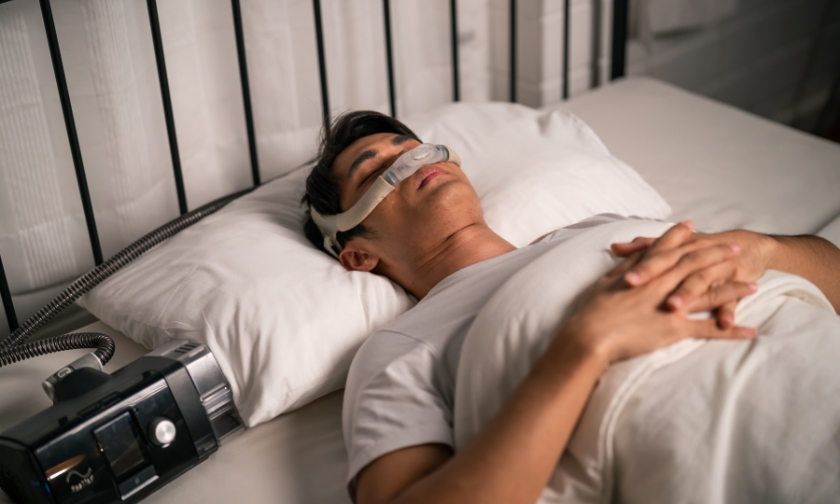
CPAP remains the standard treatment for more severe cases, delivering continuous positive airway pressure to physically hold the airway open throughout the night. For patients who struggle with CPAP compliance, combination approaches or alternative devices may be more practical.
What both treatments have in common is that when they work, the downstream effects are broad. Hormones normalize. Energy returns. The metabolic conditions that were sustaining the weight-gain loop begin to shift.
That’s not a guarantee of weight loss. But it removes one of the most stubborn obstacles to it.
Weight and sleep apnea are not separate problems with separate solutions. They’re two parts of the same physiological system, and treating them as independent issues is why so many people make limited progress on either front.
Contact Luxe Dental Arts Sugar Land today to schedule your evaluation and find out whether sleep apnea is the missing piece in your picture of good health.
People Also Ask
Can sleep apnea cause type 2 diabetes?
Yes, sleep apnea can increase the risk of type 2 diabetes. The repeated drops in oxygen levels from apnea events lead to insulin resistance, even in people of normal weight, and can worsen blood sugar control in diabetic patients.
Does the position you sleep in affect apnea severity?
Yes, sleeping on your back (supine position) can worsen sleep apnea. Gravity pulls the tongue and soft palate toward the back of the throat, blocking the airway. Some people experience positional apnea, where the condition is worse in this position.
Are there anatomical factors that cause sleep apnea in people who aren’t overweight?
Yes, conditions like a recessed jaw, enlarged tonsils, or a narrow airway can cause sleep apnea in people with normal body weight. This is often missed because sleep apnea is mistakenly linked only to overweight individuals.
Does treating sleep apnea improve cardiovascular risk?
Yes, treating sleep apnea lowers cardiovascular risk. Sleep apnea is linked to high blood pressure, atrial fibrillation, and heart attack. By treating it, you reduce the stress caused by oxygen drops, thereby improving heart health.
How long does it take to see metabolic improvements after starting sleep apnea treatment?
Improvements in energy and mental clarity can occur within weeks. However, changes in metabolic health, such as reduced insulin resistance, usually take several months of consistent treatment, depending on the severity of the condition.