info@luxedentalarts.com


For decades, if you suspected you had a sleep disorder, the path was the same: get referred to a sleep specialist, wait weeks for an appointment, spend a night in a clinical facility wired up to dozens of sensors while a technician monitored you through a camera. Then wait again for results.
The assumption baked into that process was that accuracy required a lab. That belief shaped sleep medicine for a generation. It’s now being quietly revised using better technology that fits in your bedroom.
What Each Test Measures
The Lab Study: Polysomnography
An in-lab polysomnography (PSG) is the most comprehensive sleep evaluation available. It measures brain activity via EEG, eye movements, muscle activity, heart rhythm, breathing effort, airflow, blood oxygen levels, and leg movements — all simultaneously, across a full night. A trained technician monitors the data in real time and can make adjustments if equipment shifts or a signal is lost.
PSG can diagnose not just obstructive sleep apnea but a wide range of sleep disorders: central sleep apnea, REM sleep behavior disorder, narcolepsy, periodic limb movement disorder, and others. For patients with complex or overlapping sleep conditions, it remains the most complete diagnostic tool available.
Lab studies are expensive, often require prior authorization, and have wait times that can stretch into months depending on your location. Sleeping in an unfamiliar environment attached to roughly two dozen sensors doesn’t produce the most representative night of sleep for most people – a phenomenon researchers call the “first night effect,” where sleep architecture is measurably altered simply by the lab setting itself.
Home Sleep Testing: What It Can and Can’t Do
A home sleep test (HST) is a simplified device worn on the wrist or finger, with a nasal cannula, that records data most relevant to diagnosing obstructive sleep apnea: airflow, respiratory effort, blood oxygen saturation, and heart rate. It doesn’t capture brain wave activity or muscle movement, which means it can’t diagnose the full spectrum of sleep disorders that PSG can.
When Home Sleep Testing Makes the Most Sense
The simple answer is: for most adults with suspected obstructive sleep apnea and no significant complicating health conditions, home sleep testing is not just acceptable – it’s the smarter first step.
Here’s why:
- You sleep in your own bed, in your normal environment, without sensors taped to your scalp. The data reflects how you actually sleep.
- Results are available within days rather than weeks.
- The barrier to getting tested drops considerably, which means fewer people put it off.
- For patients who are good candidates for oral appliance therapy, the HST findings provide the diagnostic foundation for initiating treatment.
The first-night effect in lab settings is real and well-documented. Some patients’ sleep is so disrupted by the lab environment that their results don’t accurately represent their typical night, which somewhat undermines the premise of high-stakes clinical monitoring.
When a Lab Study Is Still the Right Call
There are clinical situations where home testing isn’t appropriate, and in-lab polysomnography remains necessary:
- Suspected central sleep apnea, where the problem is neurological rather than mechanical
- Significant heart failure, chronic obstructive pulmonary disease, or neuromuscular conditions that affect breathing
- Suspected REM sleep behavior disorder, narcolepsy, or periodic limb movement disorder
- Prior inconclusive home sleep test results that require more detailed investigation
- Pediatric patients who require a full PSG for sleep disorder evaluation
If your symptoms suggest something beyond obstructive apnea, like there’s no snoring, breathing pauses without obvious airway collapse, and you have a significant cardiac or pulmonary history, a lab study gives your clinician the full picture they need.
For everyone else, the added complexity and cost of a lab study often don’t add diagnostic value that changes the treatment outcome.
What Happens After the Test
Diagnosis is the beginning, not the conclusion. What matters is what the results lead to.
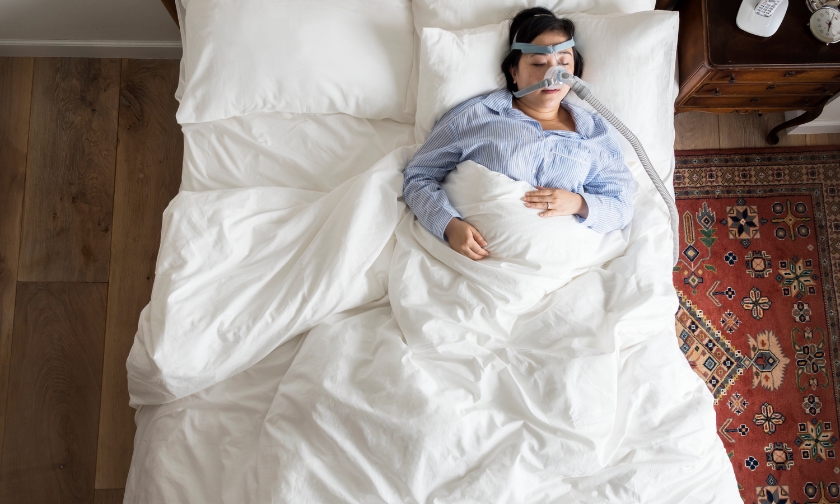
For patients diagnosed with mild-to-moderate obstructive sleep apnea, oral appliance therapy is a well-supported treatment option that works by repositioning the jaw to keep the airway open during sleep. It’s quiet, portable, doesn’t require electricity, and is significantly better tolerated than CPAP by many patients who travel frequently or find the mask uncomfortable.
Home testing and lab studies are most commonly used for diagnosis. Home testing holds up well, and for most patients, it is sufficient to start treatment sooner, with less disruption and without an unnecessary detour through a clinical sleep lab.
Contact Luxe Dental Arts in Sugar Land to schedule your home sleep test and get clarity on your sleep health without the wait.
People Also Ask
Can I use a smartwatch or fitness tracker instead of a medical home sleep test?
Smartwatches like the Apple Watch and Fitbit can track sleep patterns, but cannot diagnose sleep apnea. They may identify irregularities, but only a medical-grade home sleep test or an in-lab study can provide a proper diagnosis.
What should I do the night of a home sleep test?
Avoid alcohol and sedatives, as they can worsen apnea. Stick to your usual sleep schedule and position, and avoid excessive daytime napping. Aim for a night of sleep that reflects your normal routine.
Can home sleep testing detect if I stop breathing during sleep?
Yes, home sleep tests detect apnea events by measuring airflow, respiratory effort, and blood oxygen levels. These readings identify when breathing stops or is severely restricted, providing a clear picture of breathing disruptions.
How is the AHI score from a home test interpreted?
The AHI score measures breathing disruptions per hour. Fewer than 5 is normal; 5-14 is mild; 15-29 is moderate; 30+ is severe. Since home tests may miss some events, borderline results should be discussed with a doctor.